DxChartStackedBarSeries<T, TArgument, TValue> Class
Defines a stacked bar series.
Namespace: DevExpress.Blazor
Assembly: DevExpress.Blazor.v26.1.dll
NuGet Package: DevExpress.Blazor
Declaration
public class DxChartStackedBarSeries<T, TArgument, TValue> :
    DxChartStackedBarSeriesBase<T, TArgument, TValue>
Type Parameters
| Name | Description |
|---|---|
| T | The data type. |
| TArgument | The argument type. |
| TValue | The value type. |
Remarks
The stacked bar series displays data as a collection of rectangular bars. Values of different series are stacked in multiple-series bars. Follow the steps below to create a stacked bar series:
- Use the DxChart.Data property to specify an IEnumerable<T> data source.
- Add a
DxChartStackedBarSeriesobject to chart markup. - Use series ArgumentField and ValueField properties to specify data source fields that contain arguments and values for chart points.
- Optional. Use the Stack property to create a side-by-side bar chart.
For a sample data source, refer to our GitHub repository.
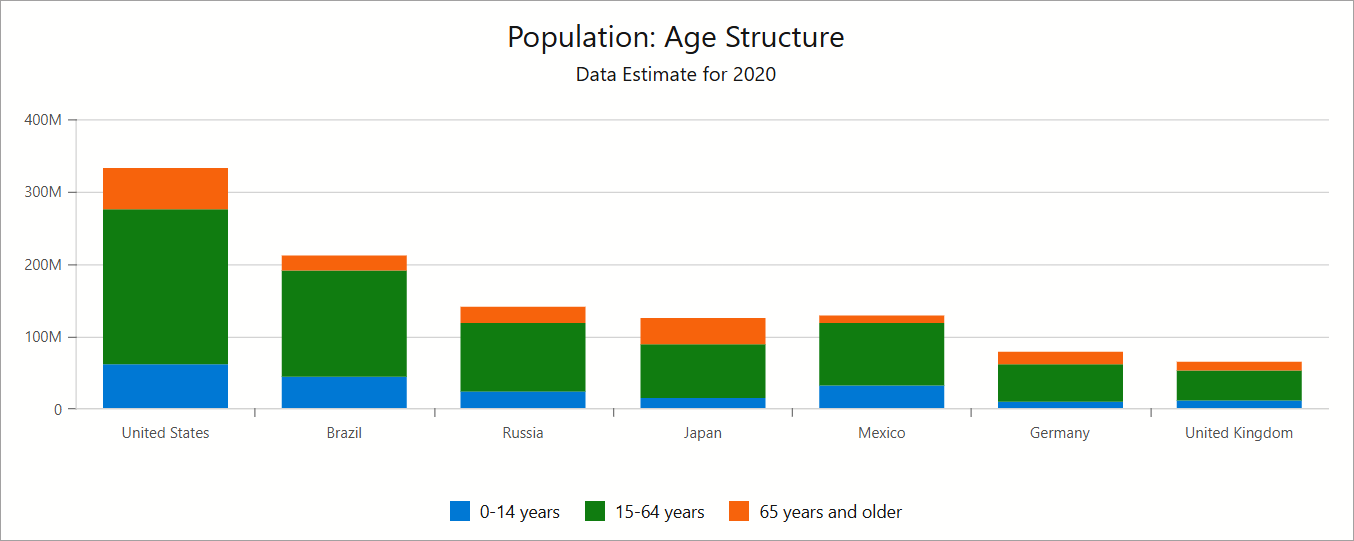
@inject IPopulationStructureDataProvider DataProvider

<DxChart T="PopulationAgeStructureItem"
         Data="@ChartsData"
         Width="100%">
    <DxChartTitle Text="Population: Age Structure">
        <DxChartSubTitle Text="Data Estimate for 2020" />
    </DxChartTitle>
    <DxChartStackedBarSeries T="PopulationAgeStructureItem"
                             TArgument="string"
                             TValue="int"
                             ArgumentField="pasi => pasi.Country"
                             Name="0-14 years"
                             ValueField="pasi => pasi.Population"
                             SummaryMethod="Enumerable.Sum"
                             Filter='pasi => pasi.AgeGroup == "0-14 years"' />
    <DxChartStackedBarSeries T="PopulationAgeStructureItem"
                             TArgument="string"
                             TValue="int"
                             Name="15-64 years"
                             ArgumentField="pasi => pasi.Country"
                             ValueField="pasi => pasi.Population"
                             SummaryMethod="Enumerable.Sum"
                             Filter='pasi => pasi.AgeGroup == "15-64 years"' />
    <DxChartStackedBarSeries T="PopulationAgeStructureItem"
                             TArgument="string"
                             TValue="int"
                             Name="65 years and older"
                             ArgumentField="pasi => pasi.Country"
                             ValueField="pasi => pasi.Population"
                             SummaryMethod="Enumerable.Sum"
                             Filter='pasi => pasi.AgeGroup == "65 years and older"' />
    <DxChartLegend Position="RelativePosition.Outside"
                   HorizontalAlignment="HorizontalAlignment.Center"
                   VerticalAlignment="VerticalEdge.Bottom" />
@* ... *@
</DxChart>

@code {
    IEnumerable<PopulationAgeStructureItem> ChartsData;

    protected override async Task OnInitializedAsync() {
        ChartsData = await DataProvider.QueryData();
    }
}
Inheritance
Object
ComponentBase
DxSettingsComponent<DevExpress.Blazor.Internal.IXYChartSeriesModel>
DxComplexSettingsComponent<DxChartSeries, DevExpress.Blazor.Internal.IXYChartSeriesModel>
DxChartSeries
DxChartXYSeries<T, TArgument, TValue, TValue>
DxChartBarSeriesBase<T, TArgument, TValue>
DxChartStackedBarSeriesBase<T, TArgument, TValue>
DxChartStackedBarSeries<T, TArgument, TValue>
See Also