Report Export
- 7 minutes to read
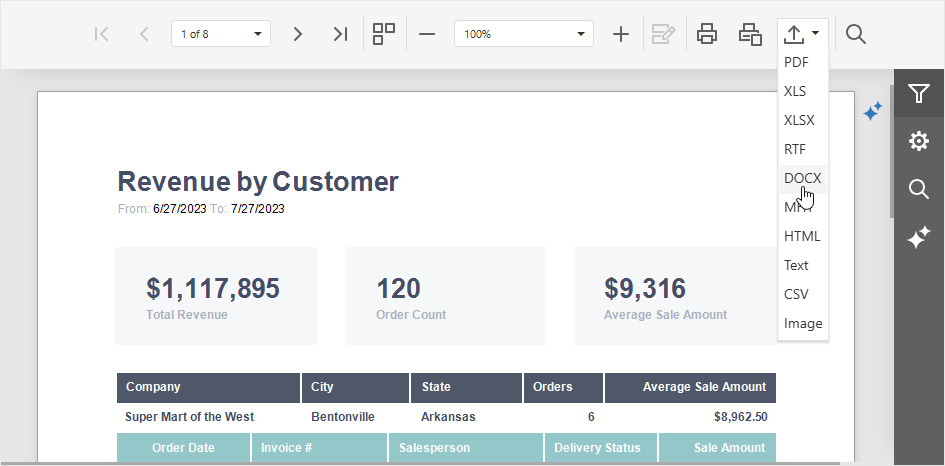
The Report Generator for Delphi and C++Builder (TdxReport/TdxReportControl) allows you to export generated documents to a format of your choice: DOCX, PDF, XLSX, CSV, RTF, etc.
Report Export APIs
This section lists all export methods declared in TdxReport and TdxReportControl classes.
Tip
Refer to individual method descriptions for detailed information and code examples.
Document Export Methods
- TdxReportControl.ExportToDOCX(System.Classes.TStream) | TdxReportControl.ExportToDOCX(System.String) TdxReport.ExportToDOCX(System.Classes.TStream) | TdxReport.ExportToDOCX(System.String)
- Export the current report to a file or stream in the Office OpenXML Document (DOCX) format.
- TdxReportControl.ExportToHTML(System.Classes.TStream) | TdxReportControl.ExportToHTML(System.String) TdxReport.ExportToHTML(System.Classes.TStream) | TdxReport.ExportToHTML(System.String)
- Export the current report to a file or stream in the HyperText Markup Language (HTML) format.
- TdxReportControl.ExportToMHT(System.Classes.TStream) | TdxReportControl.ExportToMHT(System.String) TdxReport.ExportToMHT(System.Classes.TStream) | TdxReport.ExportToMHT(System.String)
- Export the current report to a file or stream in the MIME HTML (MHT) format.
- TdxReportControl.ExportToPDF(System.Classes.TStream) | TdxReportControl.ExportToPDF(System.String) TdxReport.ExportToPDF(System.Classes.TStream) | ExportToPDF(System.String)
- Export the current report to a file or stream in the Portable Document Format (PDF).
- TdxReportControl.ExportToRTF(System.Classes.TStream) | TdxReportControl.ExportToRTF(System.String) TdxReport.ExportToRTF(System.Classes.TStream) | TdxReport.ExportToRTF(System.String)
- Export the current report to a file or stream in the Rich Text Format (RTF).
- TdxReportControl.ExportToText(System.Classes.TStream) | TdxReportControl.ExportToText(System.String) TdxReport.ExportToText(System.Classes.TStream) | TdxReport.ExportToText(System.String)
- Export the current report to a file or stream as plain text.
Image Export Methods
- TdxReportControl.ExportToImage(System.Classes.TStream) | TdxReportControl.ExportToImage(System.String) TdxReport.ExportToImage(System.Classes.TStream) | TdxReport.ExportToImage(System.String)
- Export the current report to a file or stream as an image.
Target Image Format and Export Settings
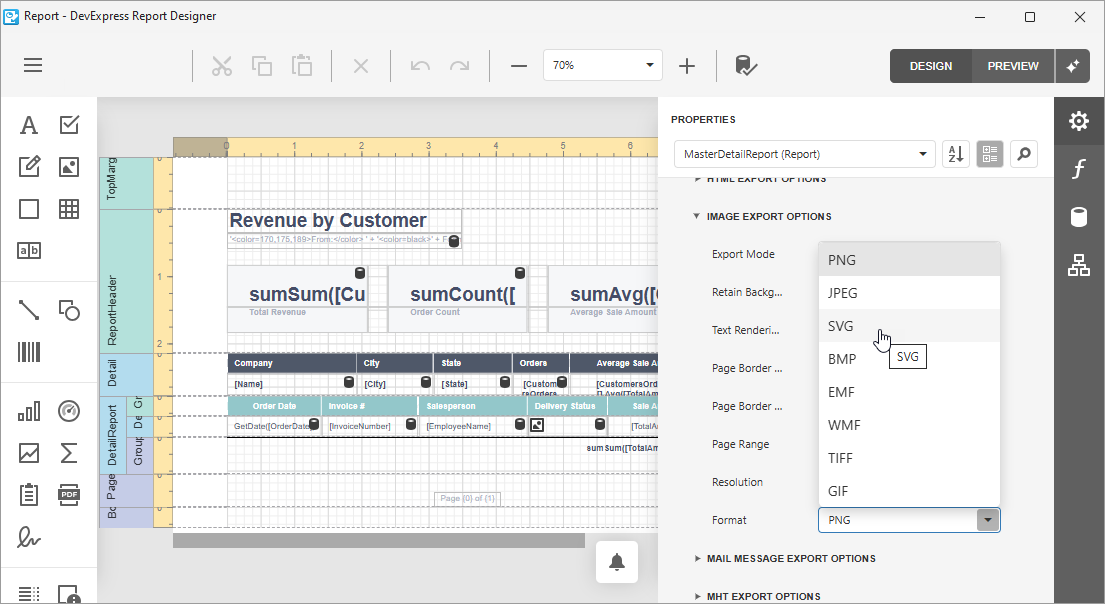
The default image export format is Portable Network Graphics (PNG).
You can select any supported image format and configure its settings in the Report Designer dialog (Behavior | Export Options):
Spreadsheet Export Methods
- TdxReportControl.ExportToCSV(System.Classes.TStream) | TdxReportControl.ExportToCSV(String) TdxReport.ExportToCSV(System.Classes.TStream) | TdxReport.ExportToCSV(System.String)
- Export the current report to a file or stream in the comma-separated values (CSV) format.
- TdxReportControl.ExportToXLS(System.Classes.TStream) | TdxReportControl.ExportToXLS(System.String) TdxReport.ExportToXLS(System.Classes.TStream) | TdxReport.ExportToXLS(System.String)
- Export the current report to a file or stream in the Microsoft Excel® binary (XLS) format.
- TdxReportControl.ExportToXLSX(System.Classes.TStream) | TdxReportControl.ExportToXLSX(System.String) TdxReport.ExportToXLSX(System.Classes.TStream) | TdxReport.ExportToXLSX(System.String)
- Export the current report to a file or stream in the Office OpenXML Spreadsheet (XLSX) format.
Universal Export Methods
- TdxReport.ExportTo(dxBackend.TdxReportExportFormat,System.Classes.TStream) | TdxReport.ExportTo(dxBackend.TdxReportExportFormat,System.Classes.TStream,System.String) | TdxReport.ExportTo(dxBackend.TdxReportExportFormat,System.String) TdxReportControl.ExportTo(dxBackend.TdxReportExportFormat,System.Classes.TStream) | TdxReportControl.ExportTo(dxBackend.TdxReportExportFormat,System.Classes.TStream,System.String) | TdxReportControl.ExportTo(dxBackend.TdxReportExportFormat,System.String)
- Export the current report to a file or stream in any supported format.
End-User Report Export Functionality
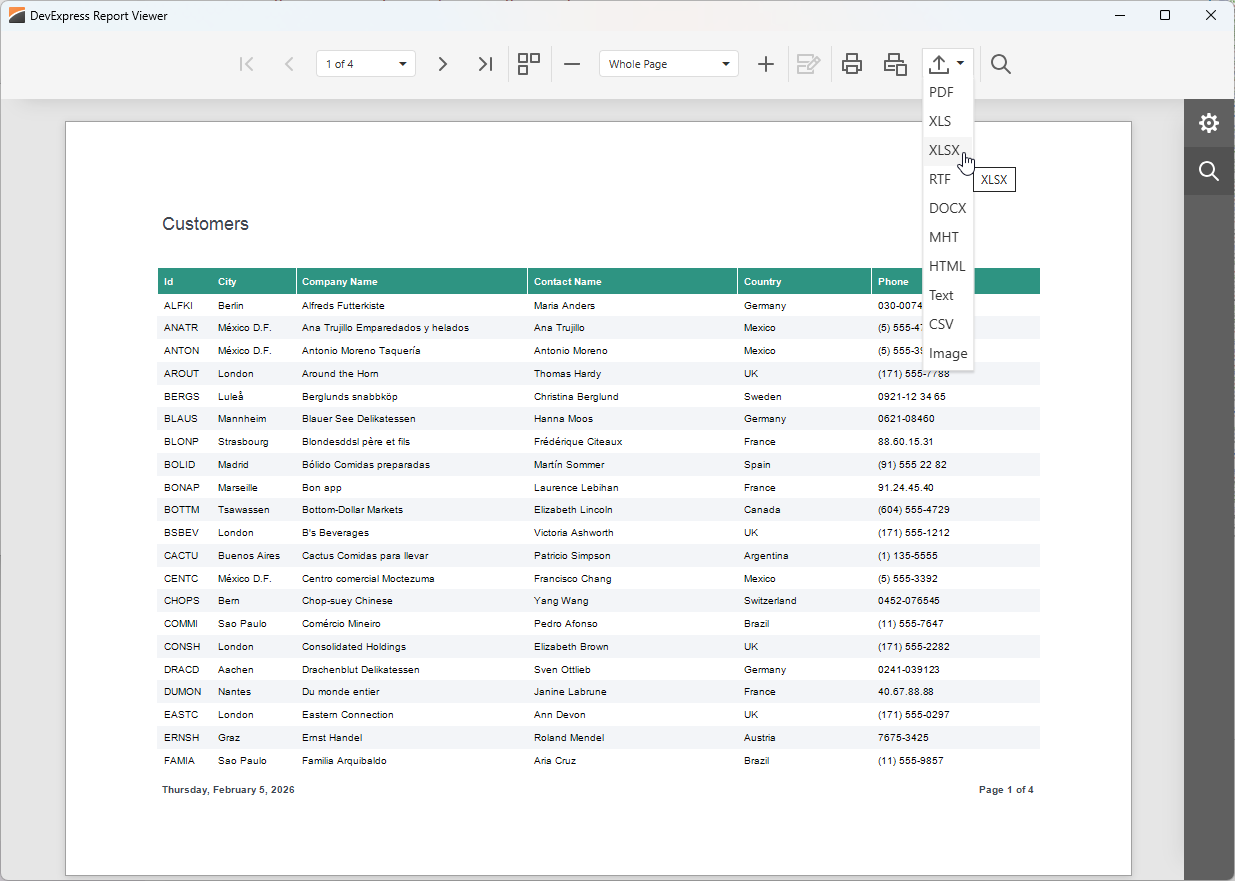
Users can export reports using the built-in drop-down menu within the Report Viewer dialog:
Export Settings
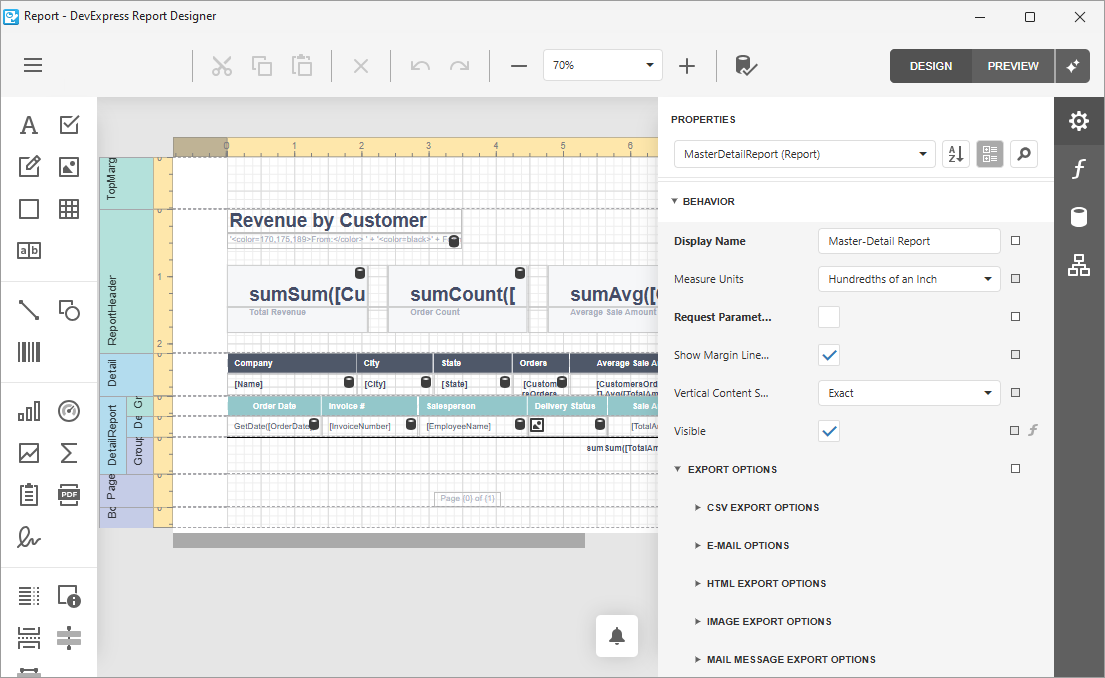
The Report Designer dialog allows users to configure export settings for all supported formats. Open the Properties tab and expand the following nodes to modify PDF export settings: Behavior | Export Options.
Export-Related Event
A click on any item in the export drop-down menu raises the OnExport event.
You can handle this event to execute custom code in response to a report export operation, modify the export target, replace the built-in Save As dialog, or prevent the operation depending on specific conditions in your application.
Note
Report export methods never raise the OnExport event.
Code Examples
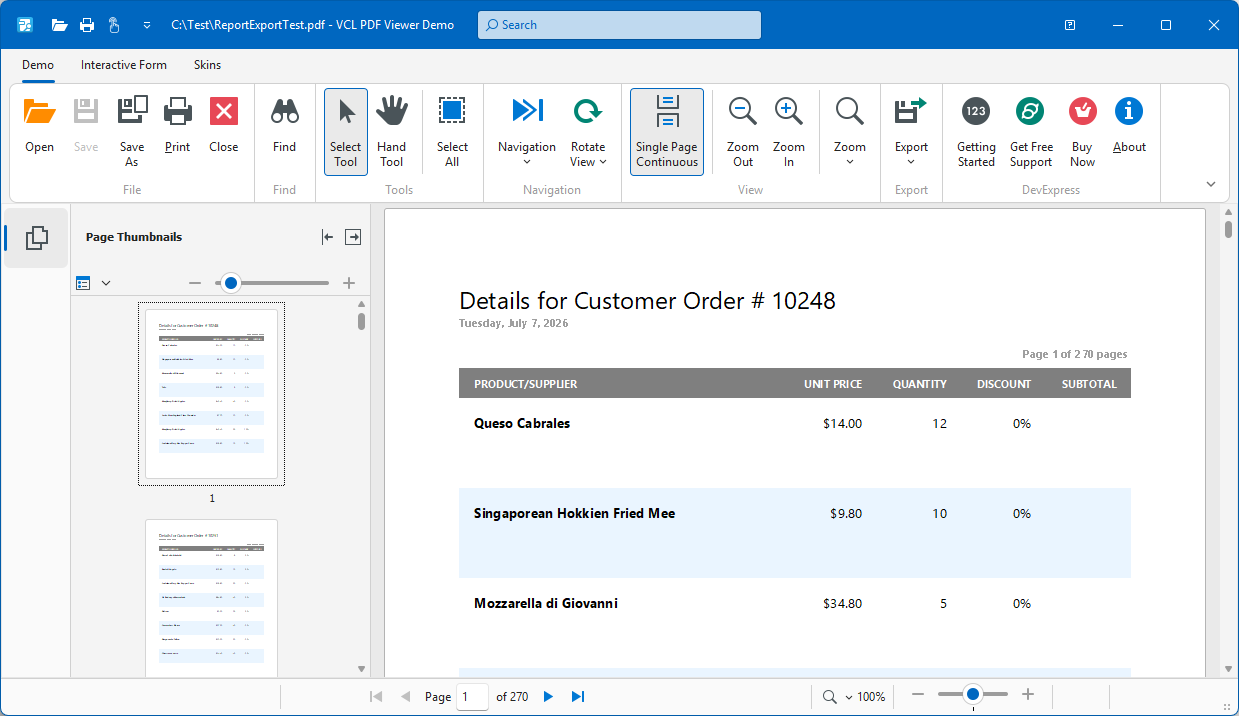
Generate and Export Report Content to PDF File
The following code example configures a memory-based data source (TdxBackendInMemoryJSONConnection), loads an REPX layout, and exports generated content to a file in the Portable Document (PDF) format without user interaction:
uses
  dxBackend.ConnectionString.JSON,  // Declares the TdxBackendInMemoryJSONConnection component
  dxSplashForms,                    // Declares the TdxSplashFormManager class and related types
  dxReport;                      // Declares the TdxReport class
// ...

procedure TMyForm.cxButtonExportToPDFClick(Sender: TObject);
var
  AReport: TdxReport;
  AJSONDataConnection: TdxBackendInMemoryJSONConnection;
  AMemoryStream: TMemoryStream;
  AJSONData: string;
begin
  // Define a table that consists of three columns ("id", "Region", and "Sales") and five data rows:
  AJSONData :=

  '[{"id": 1, "Region": "Asia",          "Sales": 4.7685},' +  // Row #1
   '{"id": 2, "Region": "Australia",     "Sales": 1.9576},' +  // Row #2
   '{"id": 3, "Region": "Europe",        "Sales": 3.3579},' +  // Row #3
   '{"id": 4, "Region": "North America", "Sales": 3.7477},' +  // Row #4
   '{"id": 5, "Region": "South America", "Sales": 1.8237}]';   // Row #5

  AJSONDataConnection := TdxBackendInMemoryJSONConnection.Create(Self);  // Creates a data connection
  try
    AJSONDataConnection.Name := 'JSONData';        // Assigns a name to the created data connection
    AJSONDataConnection.SetJSONValue(AJSONData);   // Assigns the defined JSON data string
    AReport := TdxReport.Create(Self);       // Creates a TdxReport container
    try
      AReport.Layout.LoadFromFile('MyReportLayout.repx');  // Loads an REPX Report layout
      AReport.ReportName := 'MyReport';                         // Defines a Report name
      AMemoryStream := TMemoryStream.Create;                    // Creates a memory stream
      TdxSplashFormManager.WaitForm.Show(Self);    // Displays a Wait Form before the export operation
      try
        // Export Report content to the created memory stream in the PDF format:
        AReport.ExportToPDF(AMemoryStream);
        AMemoryStream.SaveToFile(AReport.ReportName + '.pdf');   // Saves the resulting PDF file
      finally
        AMemoryStream.Free;         // Releases the memory stream
        TdxSplashFormManager.WaitForm.Hide;        // Hides the Wait Form once the operation is complete
      end;
    finally
      AReport.Free;              // Releases the TdxReport container
    end;
  finally
    AJSONDataConnection.Free;       // Releases the data connection
  end;
end;
Related GitHub-Hosted Example
This example bypasses the Report Viewer dialog and generates a report using the DevExpress Reports Backend. You can use the demonstrated technique to implement REST/Web API backends, Windows Services, workflows, and scheduled jobs for the following usage scenarios:
- Bulk export reports to PDF, DOCX, image, and other supported formats.
- Share, email, and print report documents without user interaction.
- Implement custom report management UIs.
Related Compiled Demo
To see the TdxReport print and export functionality in action, run the Report Designer/Viewer demo in the VCL Demo Center installed with compiled DevExpress VCL demos. Click different items in the sidebar on the left to select different demos. Click the Print Preview button to display the Print Preview dialog. Use built-in UI elements to test built-in export functionality.
Compiled DevExpress demos ship with source code installed in the Public Documents folder (%PUBLIC%) for all users (default). You can find all project and source code files for the Report Designer/Viewer demo in the following folder:
%PUBLIC%\Documents\DevExpress VCL Demos\MegaDemos\Product Demos\ExpressReports\
Tip
Project and source code files for all compiled DevExpress VCL Demos are maintained in a public repository hosted on GitHub: