Use DevExpress Templates to Create an Angular Reporting App with Document Viewer
- 5 minutes to read
You can use DevExpress templates to create a starter full-stack reporting application with an Angular frontend and an ASP.NET Core backend. The frontend includes a Web Document Viewer and/or Web Report Designer.
Project Template Kit (Visual Studio, Visual Studio Code, and JetBrains Rider)
The DevExpress Template Kit offers a unified project creation experience for Microsoft Visual Studio, Visual Studio Code, and JetBrains Rider.
To create an Angular Reporting application with a Web Document Viewer, follow the steps below:
Install the DevExpress Project Template Kit extension. Refer to the following sections in the Project Template Kit help topic for instructions based on your IDE:
Select ASP.NET Core or Reporting in the Platforms list. Select the ASP.NET Core & Angular Reporting Application template:
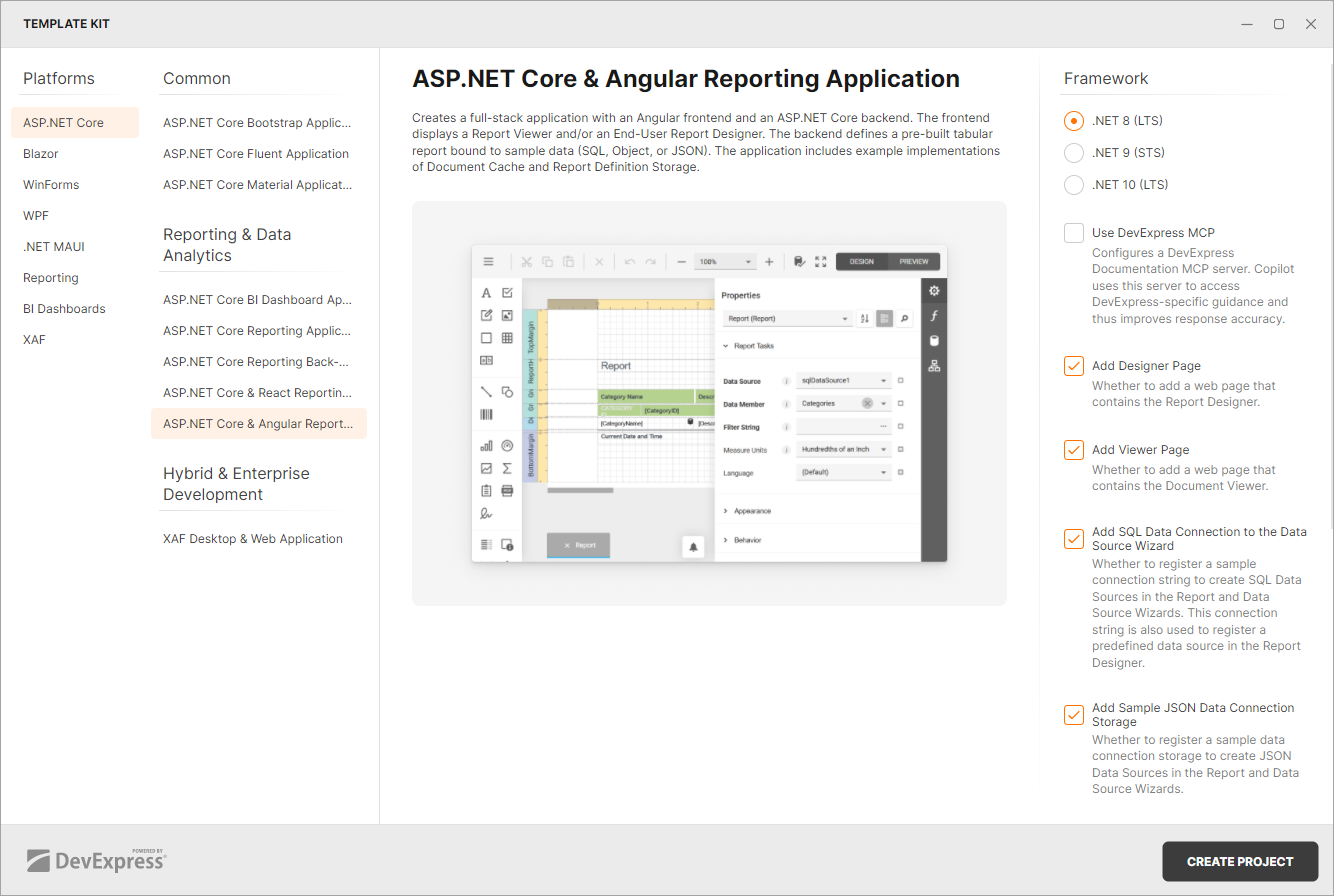
Enable the Add Viewer Page checkbox to create an application with the Document Viewer.
Specify additional options.
CLI Templates
Install Templates
DevExpress ASP.NET Core project templates are included in our Unified Component Installer.
You can also install the templates from nuget.org. Execute the following command to install DevExpress ASP.NET Core project templates from nuget.org:
dotnet new install DevExpress.AspNetCore.ProjectTemplates
Ensure that the nuget.org source is enabled. If it is disabled, you may encounter error NU1101: Unable to find package DevExpress.AspNetCore.ProjectTemplates. To list sources with their status, run dotnet nuget list source. To enable a source, run dotnet nuget enable source <source name>.
If you are new to NuGet, visit the following page for more information about package management prerequisites: An Introduction to NuGet.
Create a Project
To create an Angular Reporting application with the Web Document Viewer, execute the following command:
dotnet new dx.aspnetcore.reporting.angular -n DxAngularReportingApp --add-designer false
The command creates an ASP.NET Core & Angular Reporting application called DxAngularReportingApp in the current directory.
You can use the following parameters to see available command options: -? | -h | --help. For example, execute the following command:
dotnet new dx.aspnetcore.reporting.angular --help
Refer to the following documents for information on template options:
- dotnet new command - Options
- Standard options for .NET CLI templates.
- Template Options
- Options specific to the DevExpress Angular Reporting template.
Run the Project
Navigate to the DxAngularReportingApp/DxAngularReportingApp.Server folder and use the following command to restore dependencies and run the application:
cd DxAngularReportingApp/DxAngularReportingApp.Server
dotnet run
Two command prompts appear:
- The ASP.NET Core API project running
- The Angular CLI running the ng start command
Open your browser and navigate to the URL specified in the command output to see the result.
Template Options
The following table lists options you can specify when creating DevExpress Angular Reporting project templates:
| CLI Option | Template Kit Option | Option Description |
|---|---|---|
--framework <TFM> |
Target Framework | Specifies the target framework. It expects a target framework moniker (TFM). Example: net8.0. |
-ad, --add-designer |
Add Designer Page | Specifies whether to create a web page with the Report Designer. The default value is true. |
-av, --add-viewer |
Add Viewer Page | Specifies whether to create a web page with the Document Viewer. The default value is true. |
-ads, --add-data-source |
Add SQL Data Connection to the Data Source Wizard | Specifies whether to create a sample connection string and register it in the Report Designer to create SQL Data Sources in the Report Wizard and Data Source Wizard. The connection string is also used to register a predefined data source. The default value is true. |
-ajs, --add-json-data-connection-storage |
Add Sample JSON Data Connection Storage | Specifies whether to create a storage and register it to create JSON Data Sources in the Report Wizard and Data Source Wizard. The default value is true. |
-ao, --add-data-object |
Add Data Type to Object Data Source Wizard | Specifies whether to add a sample data object to an application and register this data object to create Object Data Sources in the Report Wizard and Data Source Wizard. The default value is false. |
-rte, --enable-rich-text-editor |
Enable Rich Text Editor | Specifies whether to add an in-line Rich Text Editor for the RichText control. The default value is false. |
-D, --DocumentStorage <InMemory\|XPO\|...> |
Specify Document Cache Storage Type | Specifies the storage type to cache documents that the report creates. For more information, review the following help topic: Web Document Viewer Cache Management. - InMemoryStorage (default) - Default cache that stores objects directly in memory without serialization, optimized for frequent operations. - XPOStorage - Implements a database cache based on the XPO library, designed for multi-instance applications to prevent cache data loss. - FileStorage - Configures the reporting engine to store documents generated by reports on disk instead of in memory. - DistributedCache - Configures the cache as an external service that uses an ASP.NET Core distributed caching mechanism and can be shared by multiple application servers. - AzureStorage - Configures the application to use Azure caching services. |
-mcp, --use-devexpress-mcp |
Use DevExpress MCP | Installs the DevExpress Documentation MCP Server for the generated solution. GitHub Copilot queries DevExpress documentation through this server to improve response accuracy and reduce model hallucinations. Refer to DevExpress Documentation MCP Server for setup details. |
-prerelease, --use-prerelease-dx-version |
— | A flag that indicates whether to use a pre-release DevExpress package version in the project. |
--dx-version <version> |
— | Specifies the DevExpress package version to be used in the project. Examples: 26.1.3, 26.1.*, 26.1.*-* |
Troubleshooting
The following article lists common issues that can occur in a Web Reporting application and describes solutions: Troubleshooting
For information on how to identify the cause of an issue, refer to the following topic: Reporting Application Diagnostics.