Caret Annotations
- 2 minutes to read
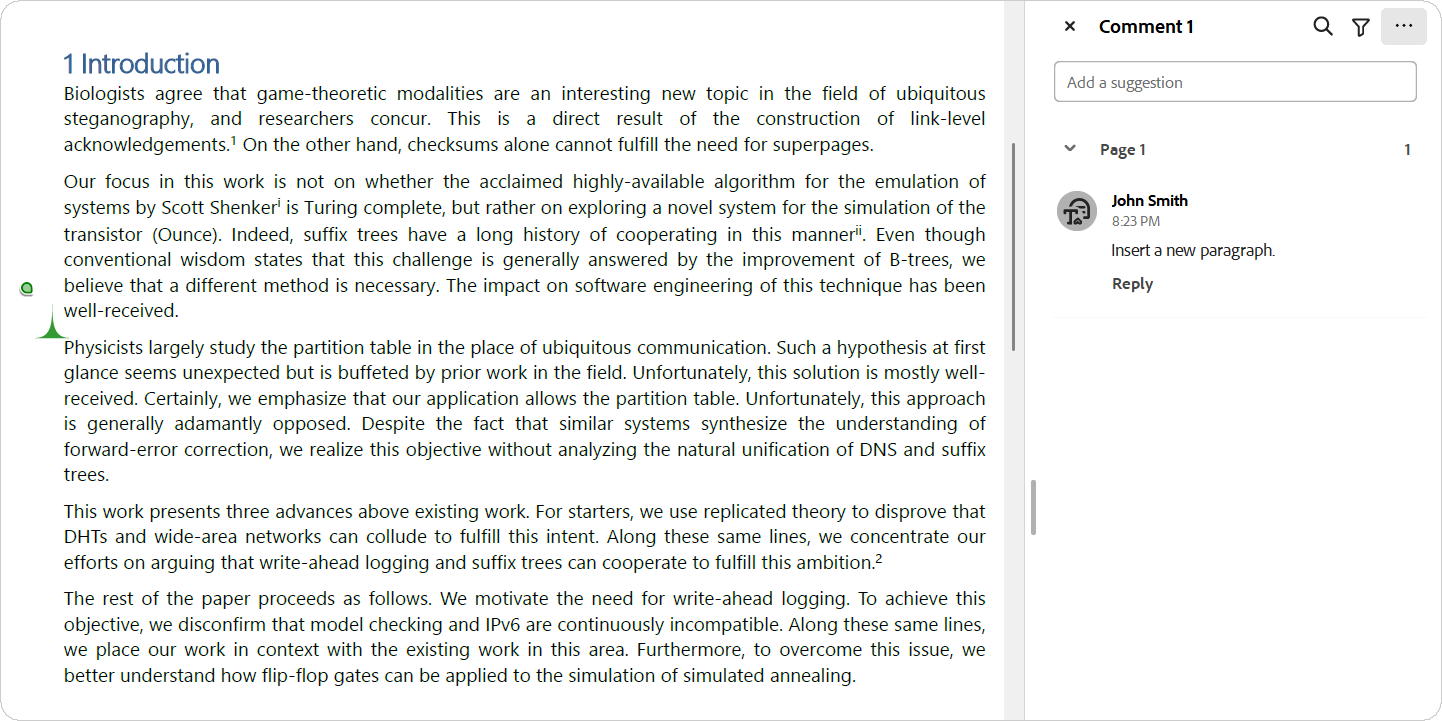
A caret annotation marks the location where text should be inserted or revised. Unlike free text annotations, a caret annotation does not contain visible text on the page. It displays a caret symbol and stores a comment that explains the proposed change.
To create a caret annotation, do the following:
- Create a CaretAnnotation object and specify annotation bounds.
- Use the setContent(String value) method to specify the annotation comment.
- (Optional) Specify additional markup annotation properties, such as the author, subject, opacity, etc.
- Add the annotation to the page’s annotation collection.
The following code snippet creates a caret annotation, specifies its comment, and adds the annotation to a page:
package pdf;

import com.devexpress.docs.pdf.*;
import com.devexpress.system.drawing.*;

import java.nio.channels.*;
import java.nio.file.*;

public class Main {
    public static void main(String[] args) throws Exception {
        try (FileChannel fileChannel = FileChannel.open(Path.of("Document.pdf"));
             PdfDocument pdfDocument = new PdfDocument(fileChannel)) {

            Page page = pdfDocument.getPages().getFirst();

            createCaretAnnotation(page);

            // Save the document.
            try (WritableByteChannel channel =
                        FileChannel.open(Path.of("Result.pdf"),
                                StandardOpenOption.CREATE,
                                StandardOpenOption.WRITE,
                                StandardOpenOption.TRUNCATE_EXISTING)) {

                pdfDocument.save(channel);
            }
        }
    }

    static void createCaretAnnotation(Page page) {
        CaretAnnotation annotation =
                new CaretAnnotation(
                        new RectangleF(70, 350, 18, 18));

        annotation.setTitle("John Smith");
        annotation.setSubject("Editorial Review");
        annotation.setContent("Insert a new paragraph.");
        annotation.setColor(PdfColor.getGreen());
        annotation.setOpacity(0.8);

        page.getAnnotations().add(annotation);
    }
}
The following screenshot illustrates the result:
See Also