Preview, Print and Export Reports
- 6 minutes to read
Preview a Report
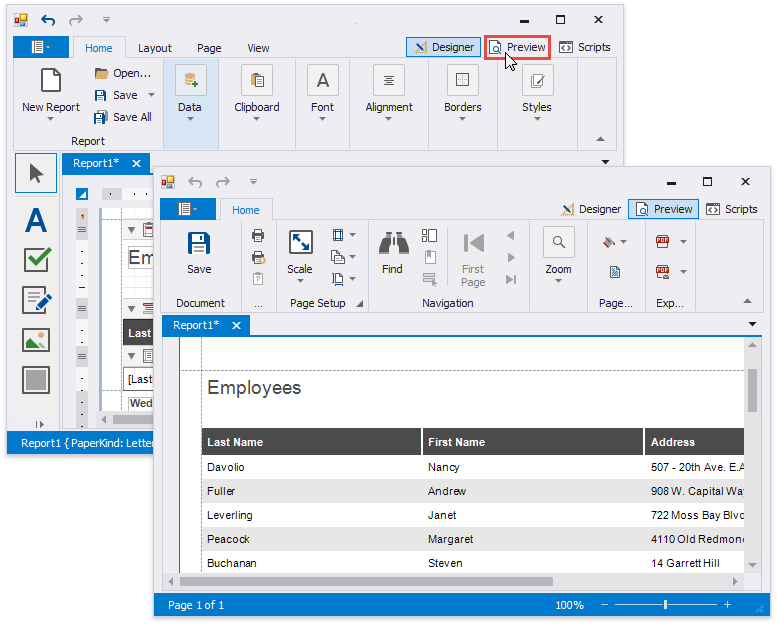
To switch a report to the print preview mode, click the Preview tab. You will see your report populated with data and broken down into pages, as specified.
Note
To learn more about the options available in the print preview mode, refer to the Print Preview for WinForms section of this documentation.
Print a Report
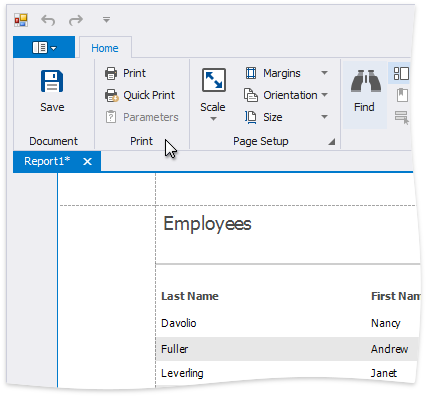
When in the Print Preview mode, you can print out your report using the appropriate menu and toolbar commands.
Export a Report
When in the Print Preview mode, you can export your report to files in different formats. The resulting files can either be saved to the hard drive or sent by e-mail.
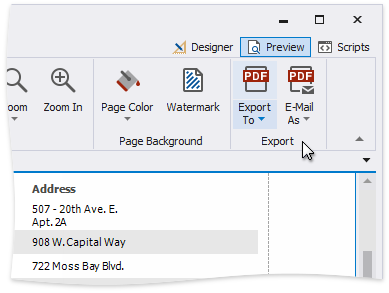
The following documents describe the basics of report exporting and format-specific export options.
- Exporting from Print Preview
- PDF-Specific Export Options
- HTML-Specific Export Options
- MHT-Specific Export Options
- RTF-Specific Export Options
- XLS-Specific Export Options
- XLSX-Specific Export Options
- CSV-Specific Export Options
- TXT-Specific Export Options
- Image-Specific Export Options
Hide Report Controls in Documents Exported to Specific Formats
You can specify the Can Publish Options setting in the Properties grid to exclude report controls from certain export formats.
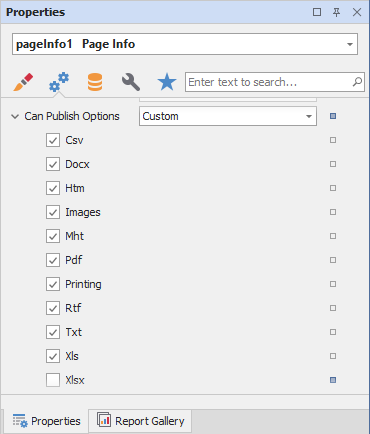
The following image illustrates the resulting XLXS document with and without page information:

Export a Report to PDF with Accessible Tags (PDF/UA Compatibility)
Use the Accessible Role option to specify how report elements should be treated by screen readers in the exported PDF document. Set the PDF/UA Compatibility property to PDF/UA-1 to conform the exported PDF document to PDF/UA specification. Then, export the report to PDF format.
Use this table to map report controls to accessibility structure roles in exported PDF files.
The table describes the following:
- How each control behaves when the Accessible Role property is set to Default.
- Roles you can assign to ensure that screen readers correctly identify the element’s purpose in the exported PDF document.
Tip
Decorative role means an element is treated as an artifact (outside the tag tree). Use this role only for non-informative visual elements.
| Element(s) | Default behavior when Accessible Role = Default | Role you can specify |
|---|---|---|
Label |
No semantic role; treated as a Div. |
Heading |
Table |
No semantic role; treated as a Div. |
Table |
Table Row |
No semantic role; treated as a Div. |
Table Header Row |
Table Cell |
Treated as a paragraph (P). |
Header Cell |
Watermark (an image watermark) |
Treated as an artifact; excluded from the PDF logical structure. | Figure |
Watermark (a text watermark) |
Treated as an artifact; excluded from the PDF logical structure. | Paragraph |
Picture Box, Shape, Bar Code, Zip Code |
Treated as a Figure. |
Decorative (Artifact) |
The Accessible Description property is not in effect for artifacts.
Define Label Accessible Role
Set the control’s Accessible Role property to Heading 1 - Heading 6 before you export a report.
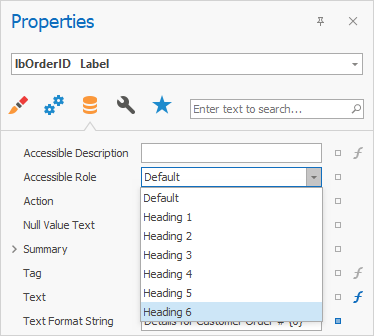
In the PDF Export Options dialog, set the PDF/UA Compatibility property to PDF/UA1 to conform the exported PDF document to PDF/UA specification. Then, export the report to PDF format.
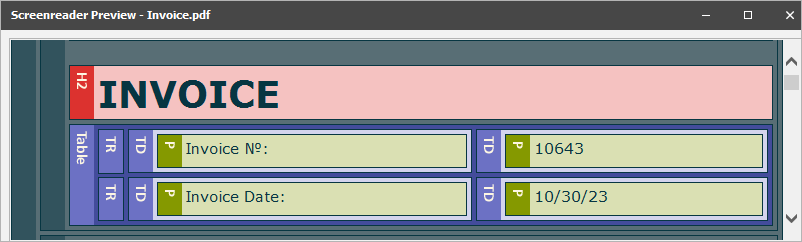
The image below shows the result. Accessible Role is set to Heading 2, and the screen reader treats Label as a “level two” heading in the exported document:
Define Table Accessible Role
You can specify how Table should be treated by screen readers in the exported PDF document. For this, set the control’s Accessible Role property to Table before you export a report.

In the PDF Export Options dialog, set the PDF/UA Compatibility property to PDF/UA1 to conform the exported PDF document to PDF/UA specification. Then, export the report to PDF format.
The image below shows the result. Accessible Role is set to Table, and the screen reader treats Table as a table in the exported document:
Define Table Row Accessible Role
You can specify how Table Row should be treated by screen readers in the exported PDF document.
Before you export a report, set the Table‘s Accessible Role property to Table to define a control as a table. Then, specify Table Row‘s Accessible Role:

In the PDF Export Options dialog, set the PDF/UA Compatibility property to PDF/UA1 to conform the exported PDF document to PDF/UA specification. Then, export the report to PDF format.
The image below shows the result. Table Row‘s Accessible Role is set to Table Header Row, and the screen reader treats Table Row as a header row of the table in the exported document:

Define Table Cell Accessible Role
Before you export a report, set the Table‘s Accessible Role property to Table to define a control as a table. Then, specify the Table Cell‘s Accessible Role property:

Note
Accessible Role is not in effect for cells merged with the Cell’s Row Span property.
In the PDF Export Options dialog, set the PDF/UA Compatibility property to PDF/UA1 to conform the exported PDF document to PDF/UA specification. Then, export the report to PDF format.
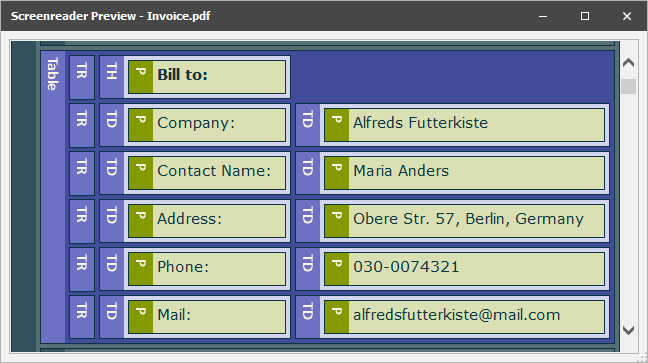
The image below shows the result. Table Cell‘s b is set to Table Header Cell, and the screen reader treats Table Cell with “Bill to:” text as a header cell in the exported document:
Define Watermark Accessible Role
Image Watermark
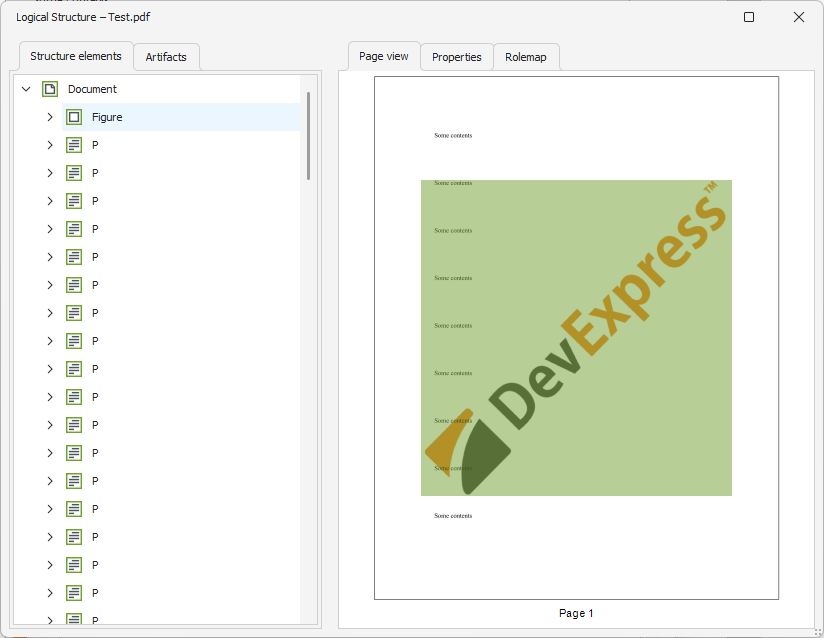
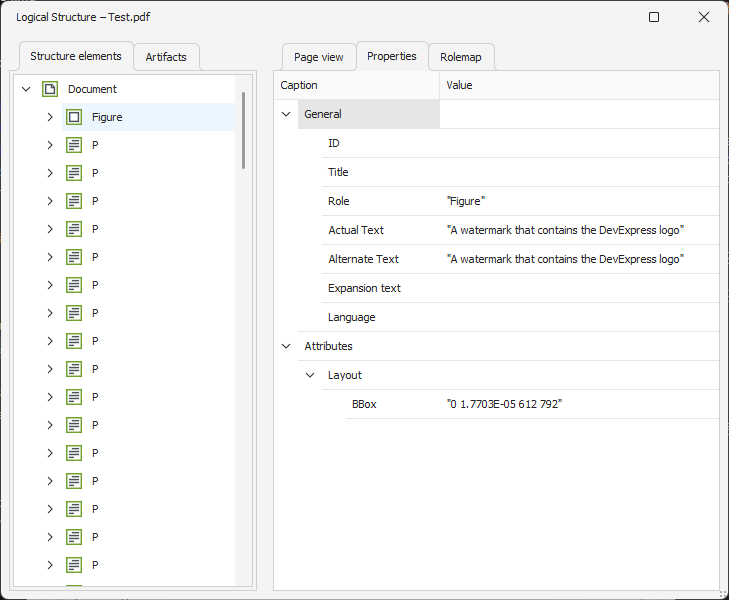
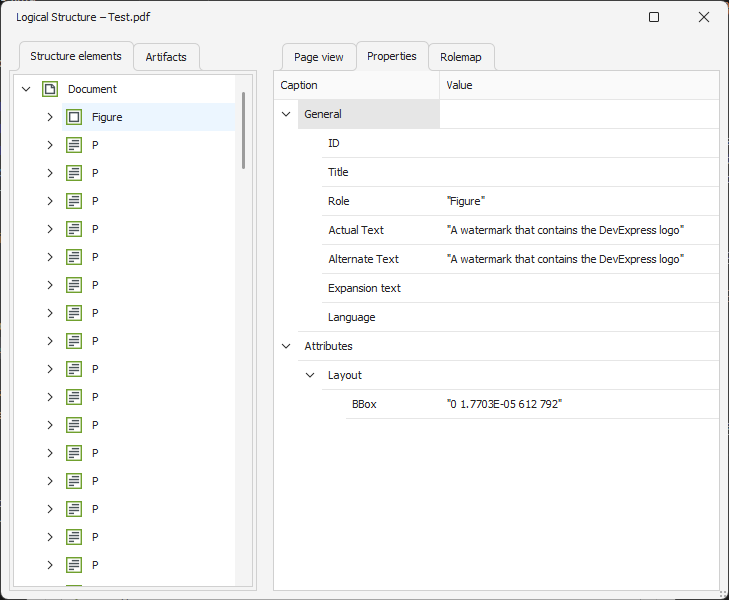
Use the Role property to specify how screen readers interpret image watermarks in exported PDF documents. You can change the value to Figure or keep the default value of Artifact. An artifact does not appear in the tag tree and is considered external to the content. The Description property is not in effect for artifacts.
If an image watermark conveys meaning and you want to include it to PDF document logical structure, set Role to Figure when you create or edit the watermark:
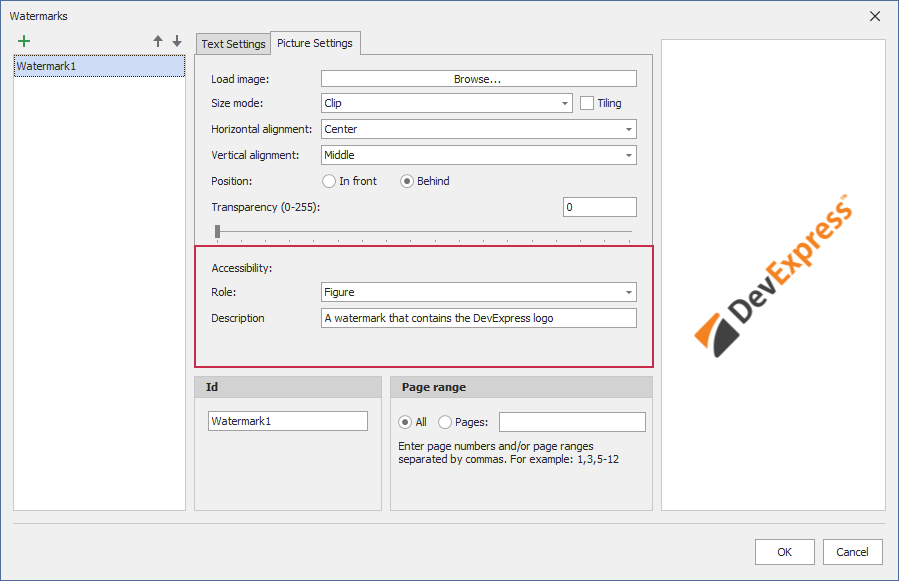
Before you export your report, set the PDF/UA Compatibility property to PDF/UA1 to make the document PDF/UA compatible.
The image below shows the result. Role is set to Figure, and the screen reader treats watermark as a figure in the exported document:
Use the Description property to specify the description of the resulting element:
Text Watermark
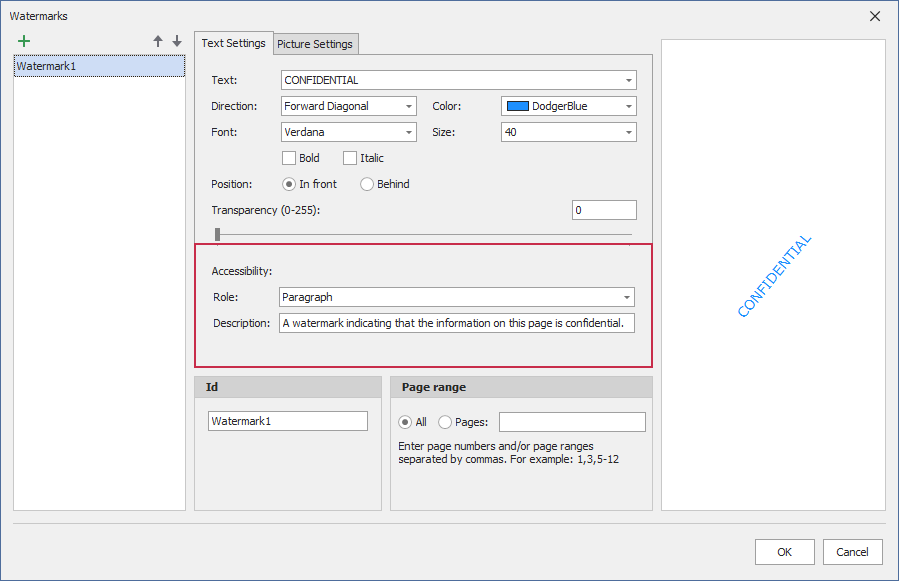
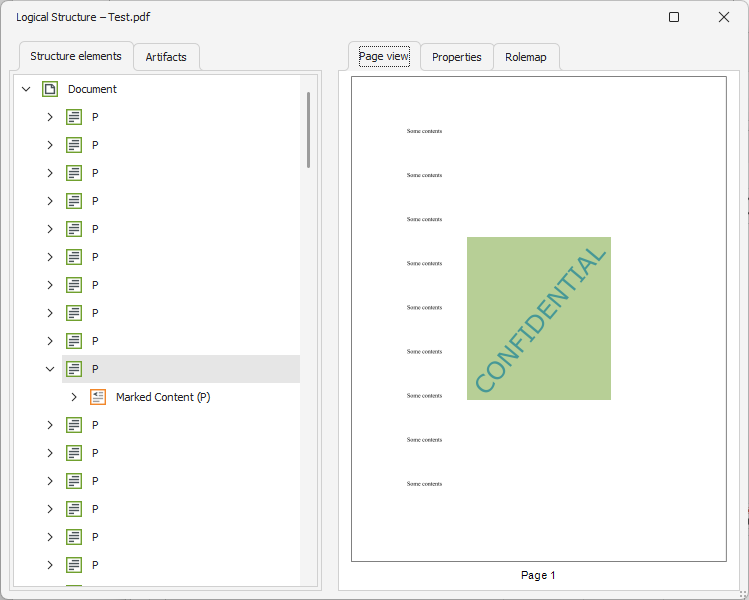
Use the Role property to specify how screen readers interpret text watermarks in exported PDF documents. You can change the value to Paragraph or keep the default value of Artifact. An artifact does not appear in the tag tree and is considered external to the content. The Description property is not in effect for artifacts.
If a text watermark conveys meaning and you want to include it to PDF document logical structure, set Role to Paragraph when you create or edit the watermark:
Before you export your report, set the PDF/UA Compatibility property to PDF/UA1 to make the document PDF/UA compatible.
The image below shows the result. Role is set to Paragraph, and the screen reader treats watermark as a paragraph in the exported document:
Use the Description property to specify the description of the resulting element:
Hide Elements from the Logical Tree
Use the Accessible Role property to specify how screen readers treat the Picture Box, Shape, Bar Code, and Zip Code controls in exported PDF documents. You can change the value to Decorative or keep the default value of Figure.
A decorative element is called an artifact and is not part of PDF document logical structure. An artifact does not appear in the tag tree and is considered external to the content.
Note
Do not exclude elements that carry meaning, use this tag only for decorative elements.