Generate Expressions from Prompts (WinForms Report Designer)
- 4 minutes to read
Prompt to Expression converts natural language into valid expressions. Instead of writing complex expressions, users describe the desired logic in plain text.
The system sends the prompt to the configured AI service, which generates a valid expression. The Expression Editor or Filter Editor displays the result immediately. If Prompt to Expression fails to create a valid expression, it displays a message that informs the user that a valid expression was not generated.
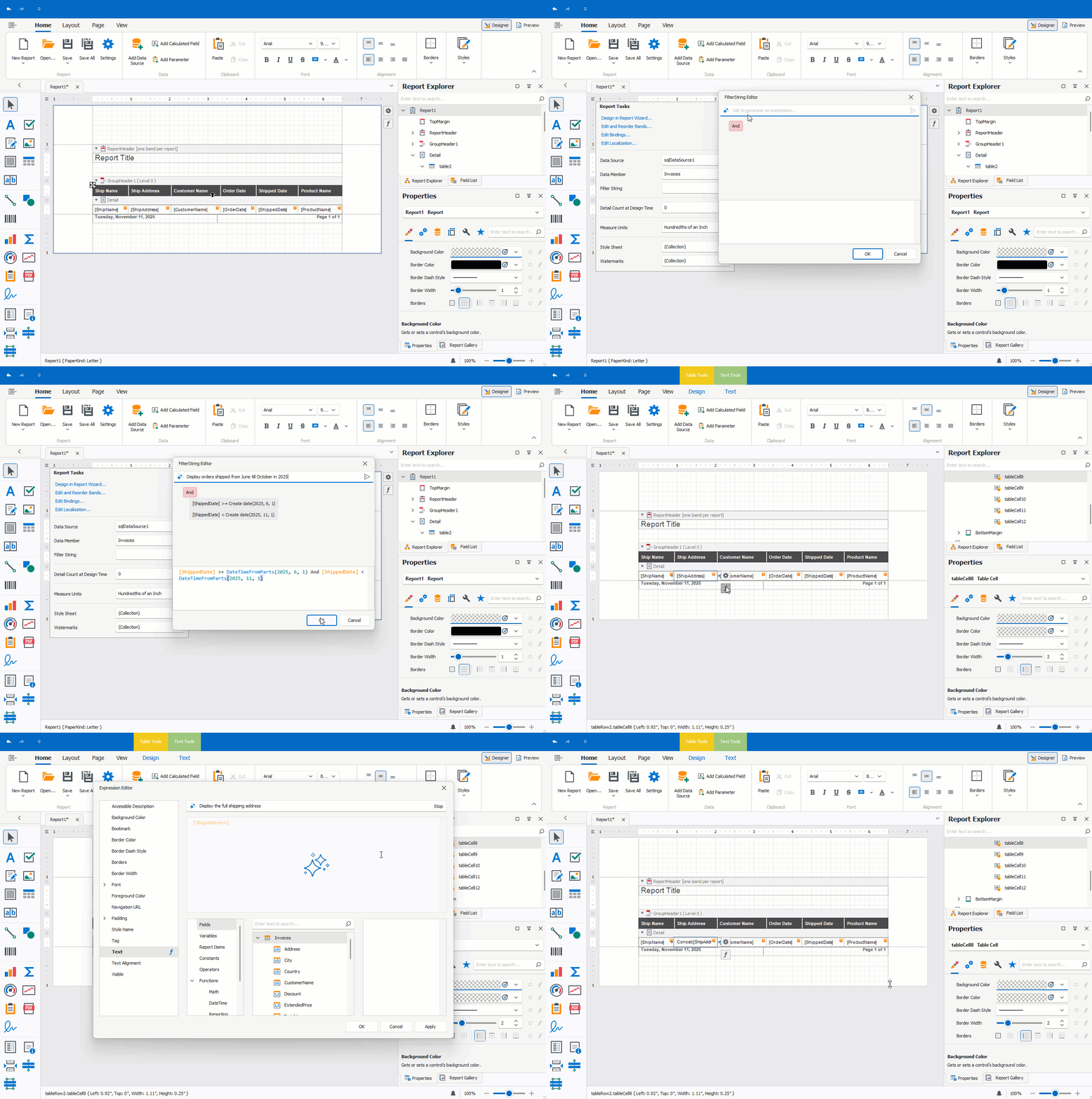
How It Works
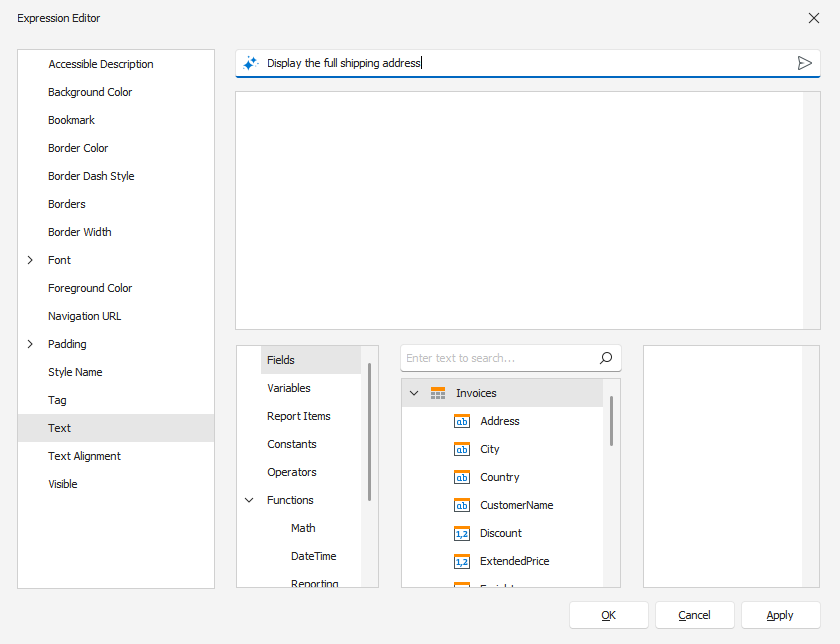
Expression Editor
The user opens the Expression Editor, enters a prompt in the Prompt to Expression field, and clicks Send.
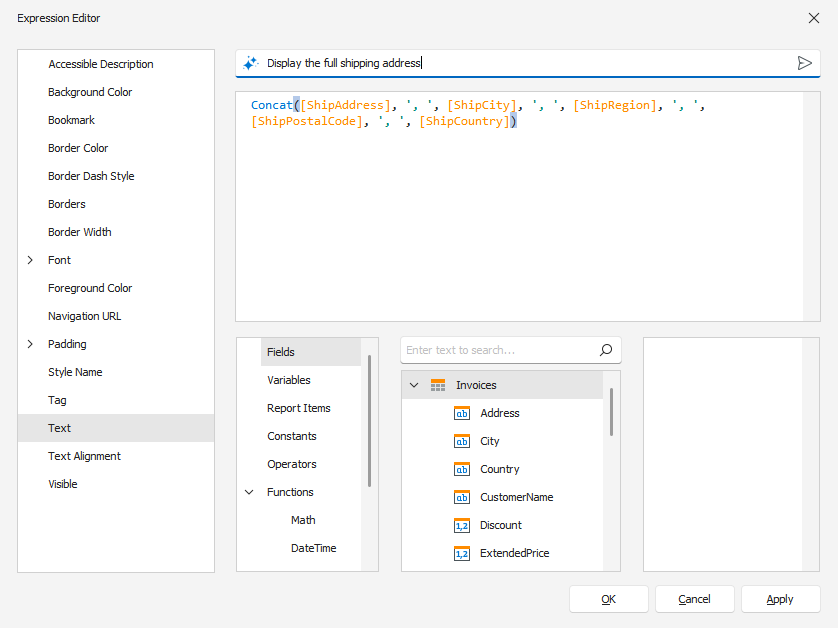
AI generates the expression and the Expression Editor displays the result.
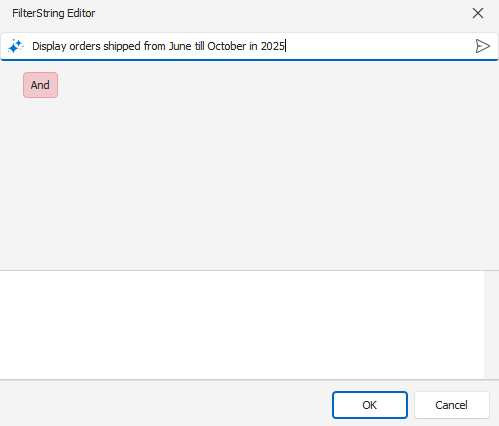
Filter Editor
The user opens the Filter Editor, enters a prompt in the Prompt to Expression field, and clicks Send.
AI generates a filter expression and the Filter Editor displays the result.
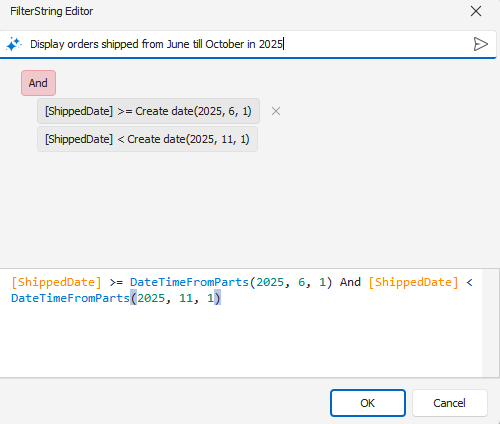
Activate Prompt to Expression
Prerequisites
- .NET 8+ SDK / .NET Framework v4.7.2
- Visual Studio 2022+
Install NuGet Packages
Install the following NuGet packages:
DevExpress.AIIntegration.WinForms.ReportingDevExpress.Win.Design(activates design-time features for DevExpress WinForms UI controls in .NET projects)- Microsoft.Extensions.AI.OpenAI (Version=”9.7.1-preview.1.25365.4”)
Azure.AI.OpenAI (Version=”2.2.0-beta.5”)
This help topic uses Azure OpenAI. See the following help topic for information about supported AI services and required NuGet packages: AI-powered Extensions.
See the following help topics for information on how to obtain the DevExpress NuGet Feed and install DevExpress NuGet packages:
- Choose Between Offline and Online DevExpress NuGet Feeds
- Install NuGet Packages in Visual Studio, VS Code, and Rider
Note
DevExpress AI-powered extensions follow the “bring your own key” principle. DevExpress does not offer a REST API and does not ship any built-in LLMs/SLMs. You need an active Azure/Open AI subscription to obtain the REST API endpoint, key, and model deployment name. These variables must be specified at application startup to register AI clients and enable DevExpress AI-powered Extensions in your application.
Register AI Client
The following code snippet registers an Azure OpenAI client at application startup:
using Azure.AI.OpenAI;
using DevExpress.AIIntegration;
using Microsoft.Extensions.AI;
using System.ClientModel;

internal static class Program {
    static string AzureOpenAIEndpoint { get { return "AZURE_OPENAI_ENDPOINT"; } }
    static string AzureOpenAIKey { get { return "AZURE_OPENAI_APIKEY"; } }
    static string DeploymentName { get { return "MODEL_NAME"; } } // For example, gpt-4.1.
    [STAThread]
    static void Main(){
        IChatClient client = new AzureOpenAIClient(
            new Uri(AzureOpenAIEndpoint),
            new ApiKeyCredential(AzureOpenAIKey))
                .GetChatClient(DeploymentName).AsIChatClient();
        AIExtensionsContainerDesktop.Default.RegisterChatClient(client);
        ApplicationConfiguration.Initialize();
        Application.Run(new Form1());
    }
}
Attach Prompt to Expression Behavior
- Drop the BehaviorManager component from the Toolbox onto a Form that contains the WinForms Report Designer.
Invoke the
BehaviorManager‘s smart tag menu and click Edit Behaviors to open the Behavior Collection Editor.Note
In .NET Framework projects, click Register AI-powered Behaviors in the
BehaviorManager‘s smart tag menu to add DevExpress AI-powered behaviors to theBehaviorManager.Add a ReportPromptToExpressionBehavior and specify its settings.
Setting Description TargetSpecifies the attached Report Designer control. RetryAttemptCountSpecifies the number of additional attempts the AI makes to regenerate an expression if the previous result is invalid. PromptAugmentation Appends additional instructions to each user prompt. Temperature Specifies creativity in AI responses. Set 1 for models (for example, GPT-5, o1, and o3 series) that ignore this parameter to avoid compatibility errors. The default value is 0.
Create and Configure Behavior Object in Code
Drop the BehaviorManager component from the Toolbox onto a Form that contains the WinForms Report Designer control. Use the following code to register a ReportPromptToExpressionBehavior and attach it to the Report Designer (reportDesigner1):
using DevExpress.AIIntegration.WinForms.Reporting;
using DevExpress.XtraEditors;

namespace ReportPromptToExpression {
    public partial class Form1 : XtraForm {
        public Form1() {
            InitializeComponent();

            // The behaviorManager1 component must be added to the Form at design time.
            behaviorManager1.Attach<ReportPromptToExpressionBehavior>(reportDesigner1, behavior => {
                behavior.Properties.MaxRetryAttempts = 5;
            });

            reportDesigner1.OpenReport(new Report1());
        }
    }
}
Note
Call the BehaviorInitializer.Initialize() method at application startup if your project targets the .NET Framework and you create AI-powered behaviors in code. Otherwise, an exception is thrown.
internal static class Program {
    [STAThread]
    static void Main() {
        //...
        // The Initialize() method forcibly initializes the behavior manager in .NET Framework apps.
        DevExpress.AIIntegration.WinForms.Reporting.BehaviorInitializer.Initialize();
        Application.Run(new Form1());
    }
}
Specific Details and Limitations
The following editors do not support Prompt to Expression:
- Filter Editor in the SQL Data Source Query Builder
- Column Expression Editor in the Federated Data Source Query Builder